

GPS Trackers for Bicycles & E‑Bikes
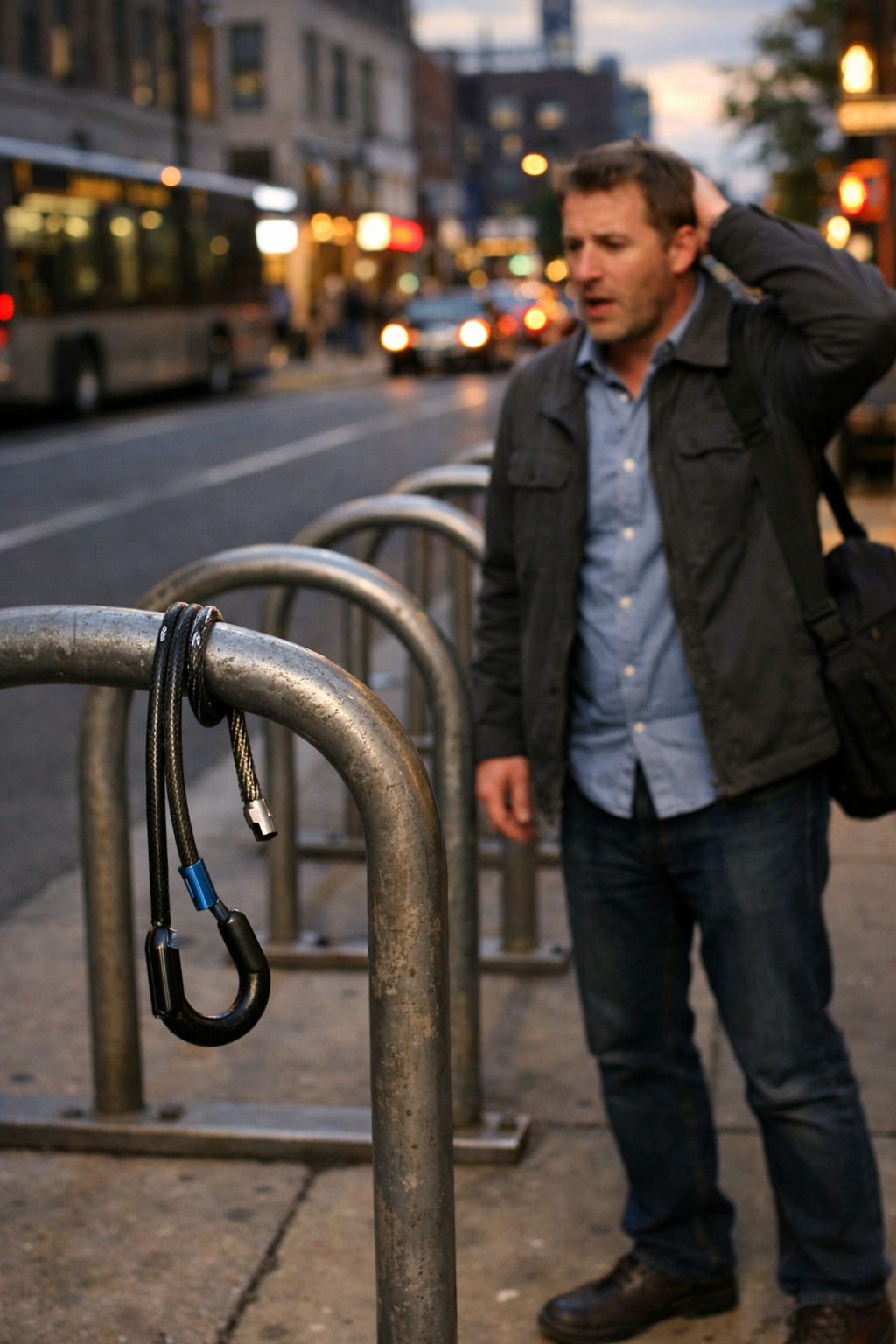
Every few minutes, somewhere in a major city, a cyclist returns to find an empty space where their bike used to be. With e-bikes now costing as much as used cars, the stakes have never been higher. This guide walks you through everything you need to know about GPS trackers for bicycles and e-bikes, from how they work to choosing the right device and getting it installed before it’s too late.
Why You Should Put a GPS Tracker on Your Bike or E‑Bike tracker
In cities like New York, London, and Berlin, a bike is stolen every few minutes. Recovery rates for untracked bikes often sit below 10%. Once it’s gone, it’s usually gone for good.
E-bikes are hit hardest. Models priced between €2,000 and €5,000 attract organised theft crews. Reports between 2020 and 2024show theft cases more than doubling in several U.S. and European cities. Motors, batteries, and displays resell fast, which makes stripping them profitable.
Locks help, but they’re not foolproof. Even high-rated U-locks can be cut with an angle grinder in under a minute. Garages get forced open. Insurance payouts take time and rarely cover full replacement cost.
Why GPS Tracking Improves Recovery Odds
Real-time GPS tracking device significantly increases your chances of recovering a stolen bike by providing precise, up-to-the-minute location information.
It gives you:
- Live location updates you can check anytime
- Instant movement alerts if someone touches or moves the bike
- Geo-fence notifications if it leaves a set area
Police data and industry reports show recovery rates can reach 70–85% when owners respond quickly after an alert.
For stronger protection, pair tracking with:
- Visible, well-lit parking
- Bike registration
- Insurance coverage
Locks slow thieves down. Tracking helps you find the bike after it’s taken. Using both creates layered protection that significantly improves recovery odds.
How Bike & E-Bike GPS Trackers Work
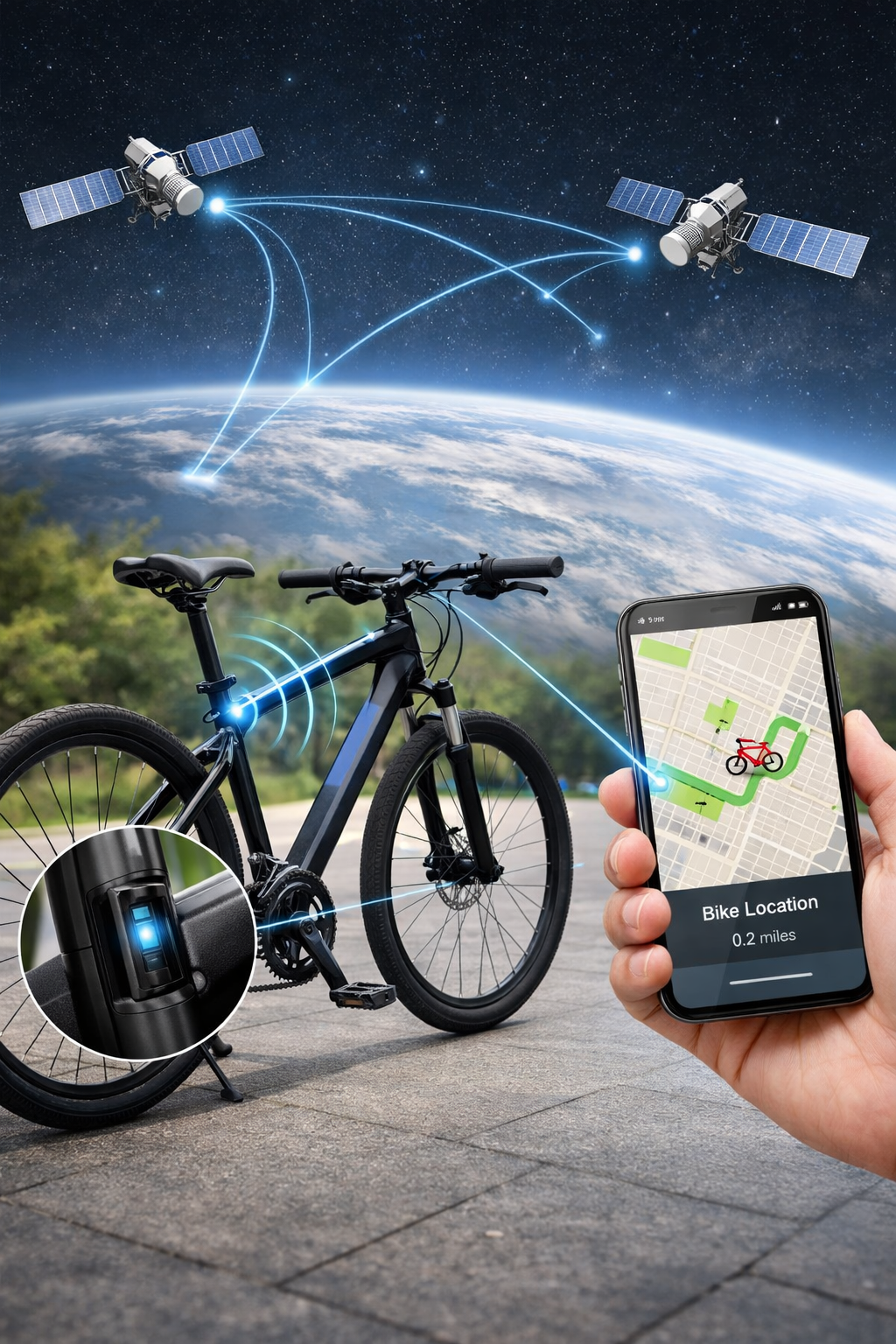
A bike GPS tracker works by calculating your bike’s location using satellites, then sending that data to your phone through a cellular network.
Understanding the system helps you choose the right device.
Satellite Positioning
GPS trackers connect to the Global Positioning System(GPS), a network of 24+ satellites orbiting Earth. When the tracker locks onto signals from at least four satellites, it calculates location using trilateration.
Under open sky, accuracy is typically within 3-5 meters.
Most modern trackers also support multiple satellite systems:
- GPS (United States)
- GLONASS (Russia)
- Galileo (Europe)
Using multiple constellations improves:
- Lock-on speed
- Location stability
- Performance in dense urban areas
Tall buildings can block signals. Multi-network support reduces that issue.
How Location Data Reaches Your Phone
For cellular GPS trackers, the process works like this:
- The GNSS chip calculates the bike’s position.
- The tracker sends that data through a cellular network (2G, 4G, LTE-M).
- You view the live location in a smartphone app or web dashboard.
When the bike is moving, updates typically arrive every 10-60 seconds. When parked, reporting slows down to preserve battery.
Power Options for E-Bikes
Many e-bike GPS trackers connect directly to the main battery. Integration is common with drive systems from brands like Bosch or Shimano.
Benefits include:
- No separate charging
- Continuous operation while the main battery has power
- Clean, hidden installation
Power usage is minimal, typically 10-50 mA, which has little impact on ride range.
Types of GPS Trackers for Bicycles and E‑Bikes
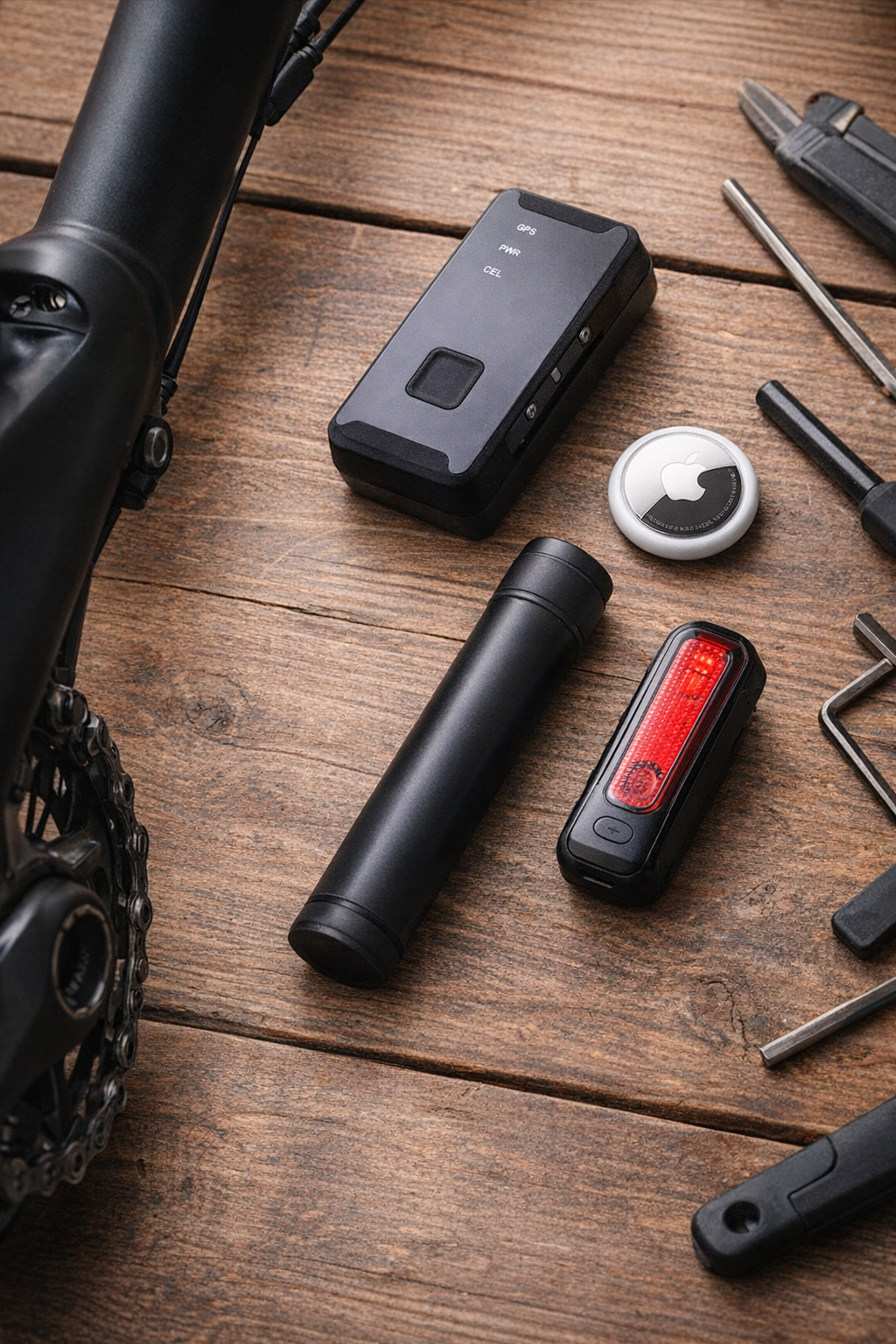
Not all “GPS bike trackers” work the same way. The category includes five distinct types, each built for a different level of security, budget, and installation preference.
Choosing the right one depends on where you ride, how valuable your bike is, and how much risk you're willing to accept.
Bluetooth-only tags
Like the Apple AirTag, Tile Sticker, or Knog Scout represent the simplest and most affordable option. These small gps tracking device options don’t contain cellular radios.
Instead, they broadcast a Bluetooth signal detected by nearby smartphones, which anonymously report the location to the manufacturer’s network.
- No subscription fees required
- Limitations: less effective in low-traffic areas or if the bike is taken indoors
- Best used as a supplementary tracking layer rather than the primary solution
Full GNSS + Cellular GPS Trackers
Full GNSS + cellular GPS trackers are compact, self-contained units that combine GPS/GLONASS receivers with 4G or LTE-M cellular modules. These devices provide comprehensive real-time tracking by sending your bike’s precise location to a cloud server accessible through an app or website. This allows you to monitor your bike’s movement live on a map during a theft or anytime you want.
Key features of full GNSS + cellular GPS trackers include:
- Integration of internal eSIM or use of a nano SIM card for cellular connectivity
- Real-time location updates, typically every 10-60 seconds when the bike is in motion
- Ability to track your bike remotely through smartphone apps or web dashboards
- Compact and weather-resistant designs tailored for bicycle user
E-bike-Specific Built-In Trackers
E-bike-specific built-in trackers offer a high level of security by integrating directly into the e-bike's power system. These trackers are installed inside the frame or motor housing and connect to the main battery, ensuring continuous power without the need for separate charging. Because they are hidden within the bike’s structure and powered by the main battery, they are difficult for thieves to detect or disable.
Key features:
- Hidden installation inside the bike frame or motor housing
- Wired GPS Tracker directly into the e-bike’s main battery for continuous power
- Difficult for thieves to detect or remove
- Often tied to specific e-bike motor brands for compatibility
Component-Style Disguised Trackers
These trackers are cleverly hidden as common bike parts such as rear lights, reflectors, seat posts, or bottle cage mounts.
Because they blend seamlessly with the bike’s components, thieves often overlook them. This design offers a balance of convenience and stealth, with battery life varying based on the specific part and tracker model.
Key Features to Consider When Choosing a Bike GPS Tracker
The ideal bicycle tracker depends on several factors, your bike’s value, where you live and park, and how you typically ride. A €500 city commuter has different protection needs than a €4,000 carbon road bike or a €6,000 cargo e-bike. Here’s what to evaluate before you purchase.
Size and form factor: Size and form factor matter more than you might think. A bulky clip-on device screams “tracker” to any thief who takes a close look. Low-profile units that hide under a bottle cage, slip inside the steerer tube, or integrate into a rear light are far harder to detect and remove. The goal is a device that stays discreetly mounted and invisible to casual inspection.
Battery and power considerations vary dramatically by tracker type:
|
Tracker Type |
Typical Battery Life |
Charging Method |
|---|---|---|
|
Bluetooth tags (AirTag, Tile) |
6-12 months |
Coin cell replacement |
|
Standalone cellular GPS |
2-6 weeks active use |
usb c rechargeable battery |
|
E-bike integrated |
Indefinite (while bike charges) |
Powered by main battery |
For standalone units, look for a usb c port for convenient charging. Long battery life matters less if you’re disciplined about weekly charging routines, but it becomes critical if you’re prone to forgetting maintenance tasks.
Connectivity technology: Connectivity technology has advanced from older 2G networks to modern 4G LTE-M and NB-IoT standards, offering better coverage and battery efficiency. Ensure your tracker supports networks active in your region.
Subscription and long-term cost: This deserve careful calculation. A tracker costing €100 with a €7/month subscription adds up to €268 over two years. Compare that against the €3,000+ cost (and immense hassle) of replacing a stolen e-bike, and the math becomes clear. Some manufacturers offer prepaid annual plans at reduced rates, so factor these options into your decision.
IP rating and durability: It should match your riding conditions. Year-round commuters parking outside need at least IP65 water resistance, while gravel and mountain bike riders should look for IP67 ratings and robust impact-resistant casings. Cheap trackers that fail after one winter exposed to the elements provide no security at all.
App and alerts functionality varies considerably between products. Core features to look for include:
- Movement/vibration alarms when the bike is supposed to be stationary
- Push notifications to your phone and email alerts
- Route history and trip history logging for your cycling adventures
- Low-battery notifications before the device goes silent
- Multi-bike management within a single account
Best Uses and Mounting Locations for Bike GPS Trackers
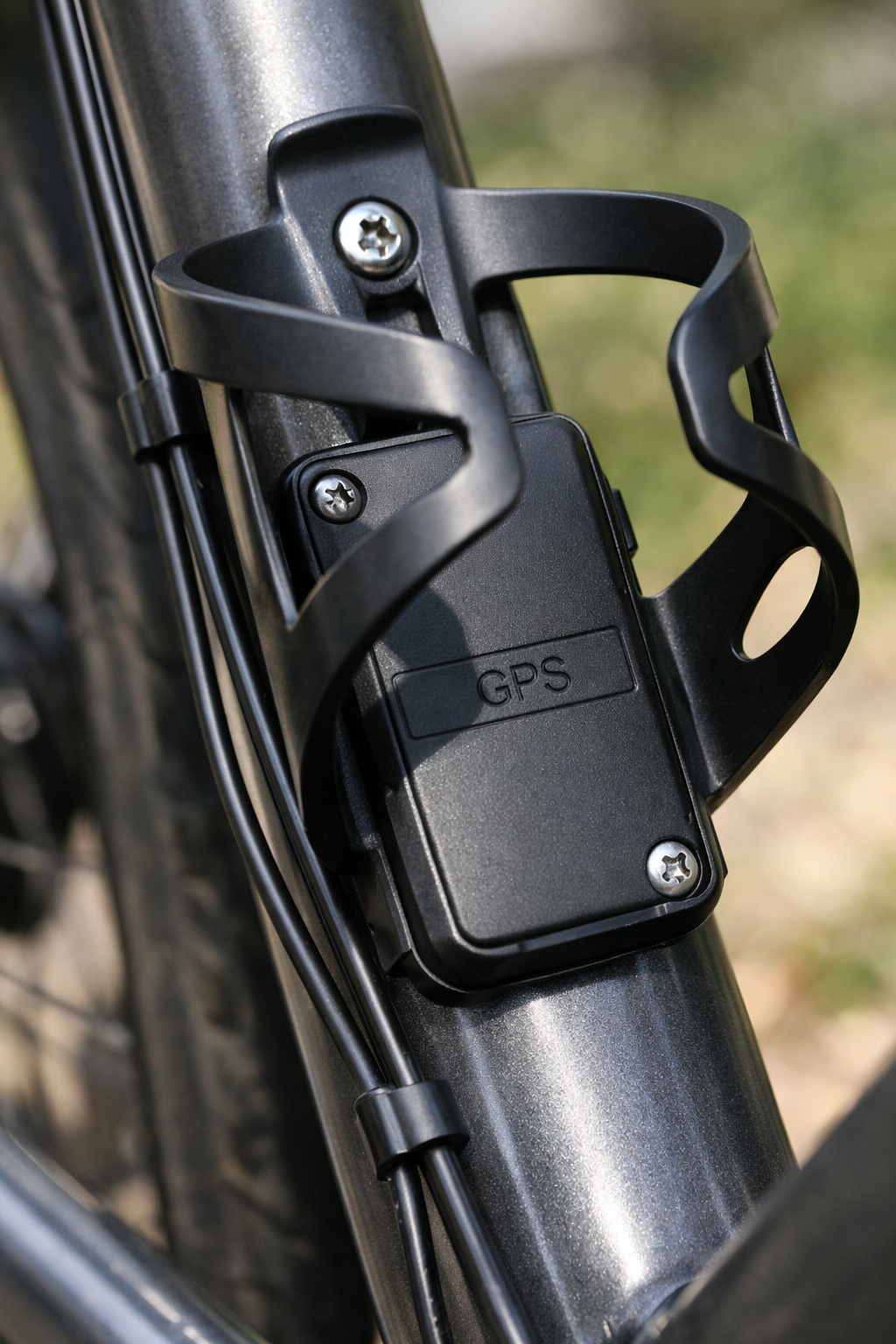
The best tracker in the world is useless if a thief spots and removes it in seconds. Placement and concealment are just as important as the device itself.
Common hidden locations that work well for aftermarket trackers include:
- Under the bottle cage: Use tamper-proof security screws to mount both the cage and tracker. Many trackers are designed specifically for this location, sitting flush against the frame’s down tube where they’re nearly invisible.
- Inside the steerer tube: The vertical tube at the front of your frame can accommodate slim trackers, completely hidden beneath the stem and headset.
- Inside the seat post: Trackers designed as seat-post inserts drop into the seat tube, concealed by the saddle and post above.
- Integrated into rear lights or reflectors: Some products replace your existing tail light with an identical-looking unit containing a hidden tracker.
E-bike-specific considerations:
E-bike-specific trackers offer unique options. Many e-bikes have compartments or motor areas ideal for hiding trackers, especially those wired into the power supply. Some manufacturers provide mounts designed for popular drive systems.
When choosing between visible alarms and hidden trackers, consider your priorities. Visible alarms may deter theft attempts, while hidden trackers improve recovery chances after theft. Many riders use both for better protection.
Installation tips to keep in mind:
- Use security screws rather than standard hex bolts
- Test GPS signal strength before final mounting, metal frames can partially block signals
- Avoid fully enclosed metal locations like cargo baskets that may attenuate cellular and GPS signals
- Document your tracker’s location in case you need to tell police exactly where to look
Real-world scenarios:
It illustrate different approaches. A city commuter parking at train stations daily needs a well-hidden tracker with strong cellular coverage and fast alerts, they may have only minutes to respond before a bike disappears into the urban maze.
A mountain biker leaving their bike on a car rack at trailheads faces different risks; a tracker with good rural coverage and long battery life suits them better. Cargo-bike owners storing their bikes in shared courtyards might combine a visible alarm system with a hidden tracker and a serious lock to create multiple deterrent layers.
The takeaway: combining a strong lock rated by independent testing labs with a discreetly mounted tracker gives you the best of both worlds. The lock slows thieves down; the tracker ensures you can locate the bike if they succeed anyway.
Legal, Privacy, and Insurance Considerations
Laws and insurance policies around bike security and tracking vary by country, so readers in the EU, UK, US, Canada, and elsewhere should verify local rules. That said, some common patterns apply broadly.
Tracking your own property is legal
In virtually all jurisdictions. Installing a gps tracking device on a bicycle or e-bike that you own and use presents no legal issues. However, installing a tracker on someone else’s bike without their knowledge or consent can constitute illegal surveillance or stalking under privacy laws in many countries. Don’t do it.
Data protection
concerns arise because GPS trackers continuously collect and transmit location data. For EU riders, GDPR requirements mean that manufacturers must clearly explain what data they collect, how long they store it, and who can access it. Look for services that store data within the EU/EEA when possible, use encrypted connections, and give you control over your location history. Reputable providers let you delete your data and close your account at any time.
Insurance benefits
increasingly reward riders who take proactive bike security measures. Some bike and e-bike insurance policies now offer premium discounts of up to 20% when a GPS tracker is installed and regularly active. Others expedite claims when tracking data helps prove theft circumstances and recovery efforts. Check with your insurer about potential savings, they may offset a significant portion of your subscription costs.
Cooperating with police
after a theft requires preparation. Many apps generate shareable links showing your bike’s live location or historical tracks that you can send directly to officers. When filing a theft report, provide this link immediately along with your bike’s frame number, photos, and purchase documentation. Speed matters: statistics show that bikes recovered within the first 1-2 hours have far better outcomes than those reported later. An immediate alert from your tracker to your phone can make this quick response possible.
Before committing to any tracking service, review their terms carefully. Key questions include:
- How long do they retain your route history?
- Do they share data with third parties for marketing or other purposes?
- What security measures protect your account from unauthorised access?
- Can you export or delete your data on request?
Your tracking data reveals patterns about where you live, work, and ride. Choose providers who treat this information with appropriate care.
Practical Tips to Make the Most of a Bike GPS Tracker
Buying a tracker is only step one. Correct setup and ongoing habits determine how effective your investment will be when it matters most.
Initial setup should include these steps:
- Create your account using a strong, unique password
- Pair the tracker with the companion app on your smartphone (iOS or Android)
- Name your bike clearly, if you manage multiple devices
- Verify that push notifications reach your phone properly before relying on the system
Configure your alerts thoughtfully to balance security with convenience. Motion alarms should activate when you park, but setting sensitivity too high leads to constant false alerts from wind or passing traffic.
Start with moderate sensitivity and adjust based on experience. Set up a geo-fence around your home and workplace, a virtual perimeter that triggers an alert if your bike exits without authorisation. Enable low-battery notifications so you never discover a dead tracker after a theft.
Establish a maintenance routine that keeps your tracker ready:
- Check battery status weekly via the app
- Recharge on a consistent schedule, many riders connect their tracker to charge whenever they charge their e bike battery
- Install software and firmware updates when the app prompts you
- Periodically verify that the device is still securely mounted and hasn’t shifted
Combine your tracker with best-practice physical security for maximum protection:
- Always lock to solid, immovable fixtures using a rated U-lock or chain lock
- Remove the e-bike display and battery when parking for long periods if possible
- Park in well-lit, busy areas or where CCTV is present
- Register your bike’s frame number with local authorities or bike registries
A well-hidden, properly set up tracker gives peace of mind and improves your chances of recovering your bike if stolen.
Conclusion
A GPS tracker for bicycles and e-bikes adds a powerful layer of protection when combined with strong physical security. Locks slow thieves down, but a tracker gives you the ability to locate your bike quickly if it disappears. With real-time alerts, location updates, and geo-fencing, many riders can respond within minutes instead of discovering the theft hours later.
Choosing the right tracker depends on your bike’s value, where you ride, and how you park. Bluetooth tags work as a simple backup, while full GNSS cellular trackers and integrated e-bike systems offer stronger recovery potential. When installed discreetly and paired with good parking habits, a tracker significantly increases the chances of getting your bike back.
For riders protecting expensive e-bikes or daily commuter bikes, the combination of a quality lock, smart parking, and a well-hidden GPS tracker creates one of the most effective anti-theft setups available.
FAQ
Do GPS trackers really work for stolen bikes?
Yes. GPS trackers can help recover stolen bikes because they provide live location data. When owners receive a movement alert and respond quickly, recovery rates reported by some manufacturers and police departments can reach 70-85%.
What is the best GPS tracker for a bicycle?
The best GPS tracker for a bicycle depends on how you use the bike. Bluetooth tags are inexpensive and easy to install, while cellular GNSS trackers provide real-time tracking and alerts. High-value e-bikes often benefit from built-in trackers connected to the main battery.
Do bike GPS trackers require a monthly subscription?
Many cellular GPS trackers require a subscription, usually between $5 and $10 per month. This fee covers cellular connectivity, cloud servers, and access to the tracking app. Bluetooth trackers typically do not require a subscription.
Where should you hide a GPS tracker on a bike?
Common hidden locations include under the bottle cage, inside the steerer tube, inside the seat post, or integrated into a rear light. A concealed tracker is harder for thieves to detect and remove.
How long do bike GPS tracker batteries last?
Battery life depends on the tracker type. Bluetooth tags can last 6-12 months on a coin battery, while standalone cellular GPS trackers usually last 2-6 weeks between charges. Integrated e-bike trackers can run continuously because they draw power from the bike’s main battery.
Are GPS trackers for bikes legal?
Yes. Installing a GPS tracker on a bike you own is legal in most countries. However, placing a tracker on someone else’s property without consent may violate privacy or surveillance laws.
Posted by Kellie Kendall on Feb 25th 2026