

Types of GPS Trackers Explained
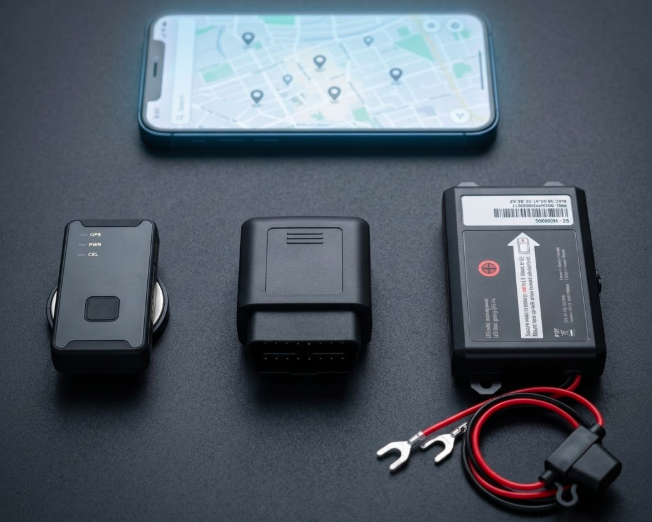
Not all GPS trackers are the same, and choosing the wrong one can leave you with blind spots when it matters most. Whether you're tracking a delivery fleet, protecting expensive equipment, or making sure your teenager got home safely, the type of GPS tracker you pick directly affects how well it works, how accurate it is, and what you'll pay.
This guide explains the main types of GPS tracking devices, how they work, and which one is the right fit for your needs.
Quick Answer: Main Types of GPS Trackers
GPS trackers come in several types, each built for a different situation, installation style, and power source. Knowing the difference helps you pick one that actually fits your needs.
Here's a quick overview:
- Hardwired vehicle trackers: Permanently wired into a vehicle's electrical system for non-stop, tamper-resistant tracking, no charging ever needed
- OBD-II plug-and-play trackers: Simply plug into your vehicle's OBD-II port under the dashboard, no tools, no wiring, ready in seconds
- Battery-powered portable trackers: Wireless and self-contained, great for trailers, equipment, and any asset that doesn't have a power source
- Asset and covert trackers: Rugged, weatherproof devices built for heavy equipment, containers, or discreet security situations
- Wearable and personal trackers: Small, lightweight devices worn by people or clipped to pet collars for personal safety and peace of mind
- Smartphone-based tracking: Uses your phone's built-in GPS for quick, no-device-needed location sharing
- Satellite and hybrid trackers: Built for remote areas where cell coverage doesn't reach, from mountain roads to offshore platforms
The right choice depends on what you're tracking (vehicles, tools, people, or pets) and where it operates (city streets, rural areas, or off the grid entirely).
What Is a GPS Tracker and How It Works
A GPS tracker combines a GPS receiver with a communication module that transmits location data to a software platform or mobile app. This allows users to monitor positions, review trip history, and receive alerts from virtually anywhere. Modern GPS tracking relies on the U.S. Global Positioning System, which currently includes 31 active satellites as of 2026. The tracker calculates its precise location through trilateration, using signals from at least four GPS satellites to determine latitude, longitude, and altitude with accuracy typically within 2-5 meters under optimal conditions.
Beyond basic location, GPS devices can transmit data including speed, heading, ignition status, and for vehicle trackers, engine diagnostics like fault codes, fuel levels, and RPM readings via CAN bus protocols. This GPS data feeds into cloud-based tracking software that delivers real-time dashboards, automated alerts, and historical reports.
The key difference between passive GPS in a smartphone and a dedicated GPS tracking device lies in design purpose. Dedicated trackers are engineered for continuous tracking, tamper resistance, and integration with fleet management software, capabilities that go far beyond occasional location sharing.
Core Types of GPS Trackers by Installation and Power
Installation method and power source are key to classifying GPS trackers. These factors impact device reliability, tamper resistance, and update frequency.
The main types include hardwired units connected to a vehicle’s electrical system, OBD-II plug-in trackers for quick installation, and battery-powered portable devices suited for assets without power sources.
Hardwired Vehicle GPS Trackers
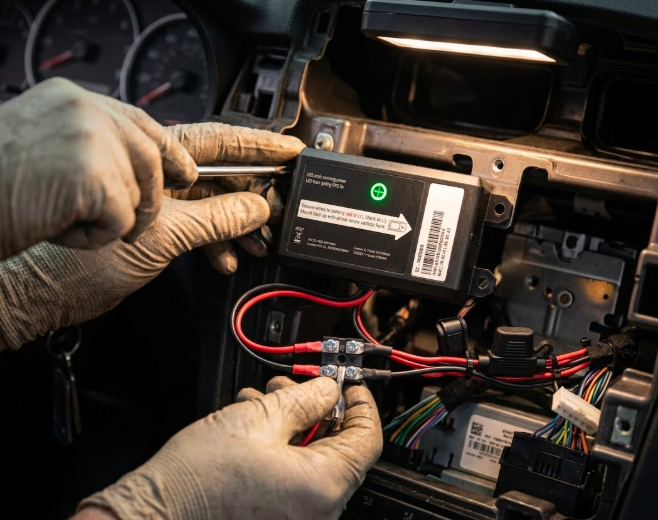
Hardwired GPS trackers connect directly to a vehicle’s electrical system, typically installed behind the dashboard or fused into the ignition circuit. Drawing constant 12V or 24V power, these devices operate 24/7 without battery concerns.
This installation approach makes hardwired units ideal for commercial fleets, logistics operations, and construction companies tracking high-value equipment. Key benefits include:
- Tamper resistance: Hidden installation makes unauthorized removal difficult
- Ignition sensing: Detects when vehicles start and stop
- Engine diagnostics: Access to CAN bus data for fault codes, fuel consumption, and maintenance alerts
- Consistent updates: Reliable 10-30 second intervals while moving
Installation typically requires a trained technician and takes 30-90 minutes per vehicle depending on model year and wiring access. Fleet managers often choose hardwired solutions for long-term contracts where the upfront installation effort pays off through years of reliable vehicle tracking.
OBD-II Plug-and-Play GPS Trackers
OBD-II GPS trackers plug directly into your vehicle's diagnostic port, the small slot found under the dashboard in most cars made after 1996. Installation takes seconds. No tools, no wiring, no professional help needed.
Once plugged in, these trackers do more than just show location. They also pull live vehicle data including:
- Fault codes and engine health alerts
- Battery voltage
- Driving behavior (speed, hard braking, rapid acceleration)
- Mileage reporting
This makes them especially useful for maintenance tracking, driver monitoring, and mileage logs.
The biggest advantage is flexibility. You can move the tracker from one vehicle to another in seconds, making it a smart choice for shared vehicles or short-term tracking needs. One thing to keep in mind: OBD-II trackers only work with vehicles that have an OBD port. Most cars built after 1996 do, but older vehicles and some heavy-duty trucks may not.
Best for:
- Small fleets without a dedicated installation team
- Parents monitoring teen drivers
- Rideshare or delivery drivers who need quick, hassle-free setup
- Anyone who moves between multiple vehicles regularly
Battery-Powered Portable GPS Trackers
Portable GPS trackers run on internal batteries, so they don’t need any connection to a vehicle or external power source. You can place them on almost any asset and start tracking immediately. Battery life depends heavily on how often the device reports location. Trackers sending updates every 15-30 seconds usually last around 7-14 days, while low-frequency setups can run 12-18 months on larger battery packs. If you need something in between, Lightning GPS's 140-Day Long Life Tracker is a good example, it runs up to 140 days on a single charge, making it ideal for equipment and assets you can't recharge every week.
These trackers are commonly used for:
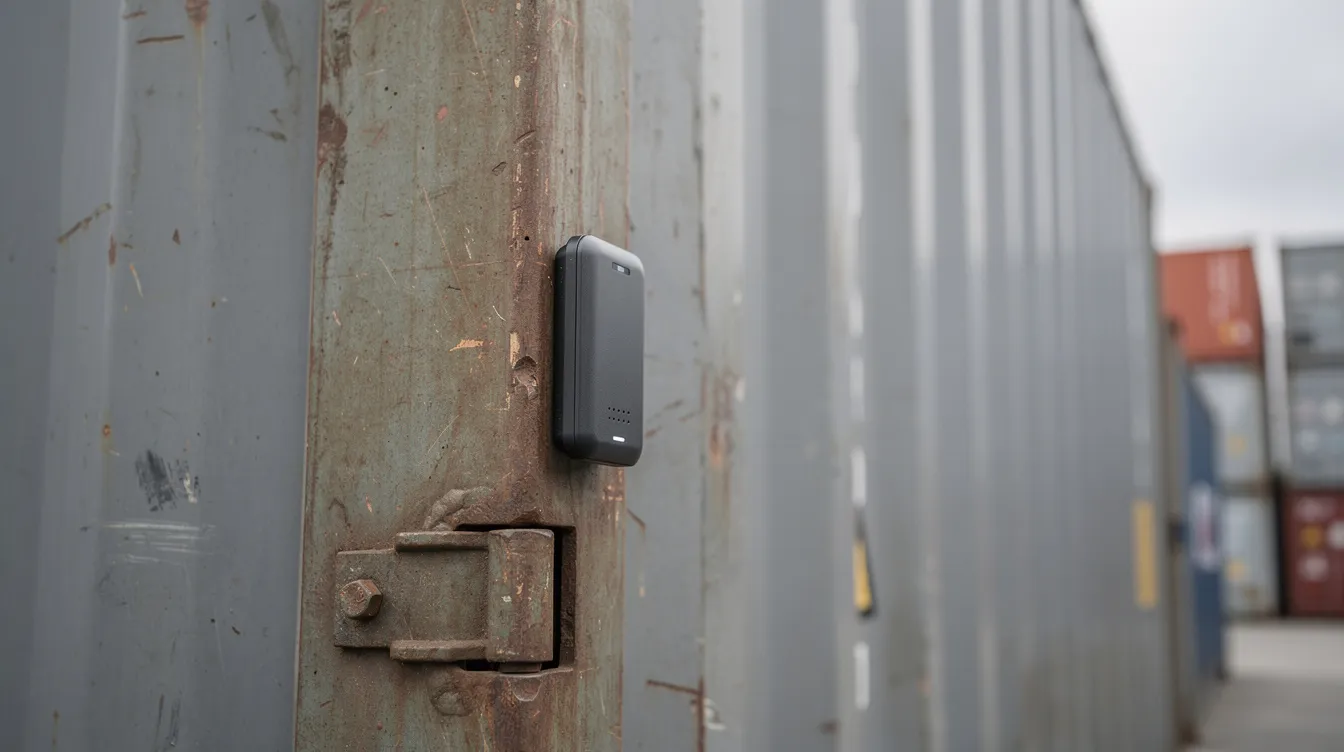
- Trailers and shipping containers
- Mobile generators and compressors
- Toolboxes and high-value equipment
- Temporary vehicle tracking where wiring isn’t possible
In real use, flexibility is the biggest advantage. You can move the same tracker between assets without installation or downtime. Most units include strong magnetic mounts, making them quick to deploy on metal surfaces. Placement matters, though, secure mounting improves signal strength and reduces the risk of the device being spotted or removed.
Tracker Types by Use Case and Form Factor
Beyond power and installation, GPS tracking devices are categorized by what or who they’re designed to follow. Each category prioritizes different features, some emphasize driver analytics, others focus on theft recovery, and personal devices prioritize safety features over fleet metrics.
Vehicle GPS Trackers (Cars, Vans, Trucks)
Vehicle GPS trackers encompass both hardwired and OBD-II devices optimized for cars, vans, and trucks operating on public roads. These GPS vehicle tracking solutions focus on:
- Real-time location and route history
- Driver behavior monitoring (speeding, harsh braking, excessive idling)
- Maintenance scheduling based on mileage or engine hours
- Theft recovery and unauthorized use alerts
For commercial fleets, the business case is compelling. Studies show GPS-enabled fleet tracking can reduce fuel costs by 20-30% through route optimization and idle time reduction.
Asset and Equipment GPS Trackers
Asset trackers are built tough. They're designed for equipment that doesn't always have a power source, think trailers, shipping containers, farm machinery, and construction equipment sitting in a field or on a job site.
These devices are made to handle rough conditions:
- Weatherproofing (IP67 or better ratings)
- Shock and vibration resistance for harsh environments
- Temperature tolerance from -40°C to 85°C
- Extended battery life with infrequent reporting
Asset tracking often uses movement-triggered updates rather than constant streaming, reporting every 5-30 minutes when assets are in motion. Construction companies use these devices to track mileage, monitor equipment utilization, and recover stolen machinery, with some operators reporting 30-50% improvements in equipment utilization after deployment.
Covert and Security-Focused GPS Trackers
Covert trackers are designed to stay hidden. They're small, sometimes under 1.5 inches with internal antennas and motion-activated modes that keep them quiet until movement is detected, saving battery life in the process.
They're commonly used for:
- Theft recovery on luxury or high-value vehicles
- Securing tool kits and valuable equipment
- Monitoring cargo during long-distance transit
Most covert trackers have no visible LED lights and keep their electronic presence minimal so they're harder to detect. Hidden tracking comes with legal responsibilities. Laws around covert GPS use vary by location. Always check your local rules and get proper consent before placing a tracker on any vehicle or belonging you don't own.
Wearable and Personal GPS Trackers
Wearable trackers come in many forms, wristbands, pendants, clip-on devices, and smartwatches. They're built for tracking people, not vehicles.
Common users include:
- Parents tracking children walking to school
- Families monitoring elderly relatives with dementia
- Employers monitoring lone workers in remote or high-risk locations
- Pet owners using collar-mounted trackers
Common safety features include SOS emergency buttons, fall detection via built-in gyroscopes, geofencing alerts when wearers leave designated safe areas, and two-way voice communication. Design priorities emphasize comfort, simple interfaces, and battery life lasting at least a full day.
Personal tracking requires balancing safety benefits with privacy considerations, always obtain consent when monitoring adults.
Smartphone-Based Tracking Apps
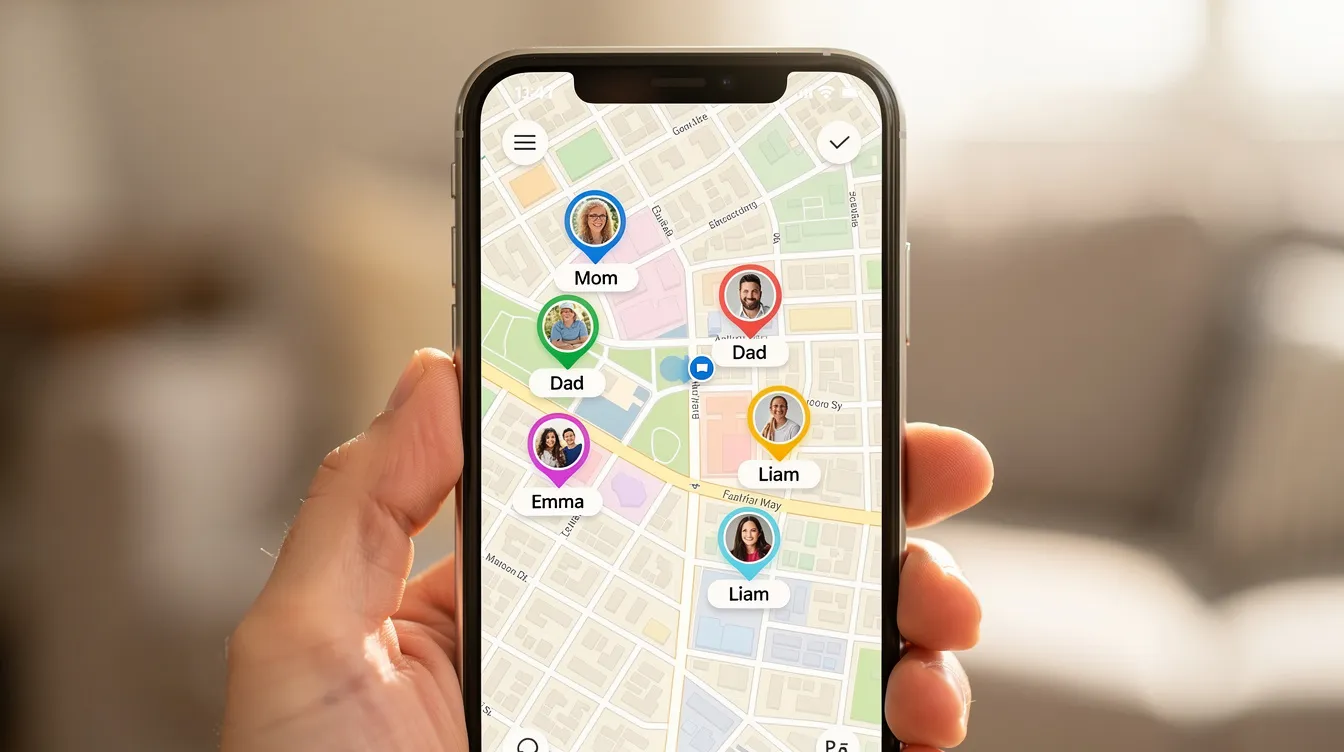
Your smartphone already has GPS built in. Apps like Apple's Find My or Google's location sharing let you track family members or teammates without buying any extra hardware. This works well for casual, short-term use, sharing your location with family, coordinating a small field team, or temporarily keeping tabs on a driver.
But for business use, the limitations are real:
- The phone has to be on and connected at all times
- Anyone can simply turn off location sharing
- Constant tracking drains the battery by 10-20% per day
- It's simply not as dependable as a dedicated GPS device
Most businesses use phone-based tracking as a backup for field staff, not as a replacement for proper vehicle or asset trackers.
Connectivity Types: Cellular, Satellite and Hybrid Trackers
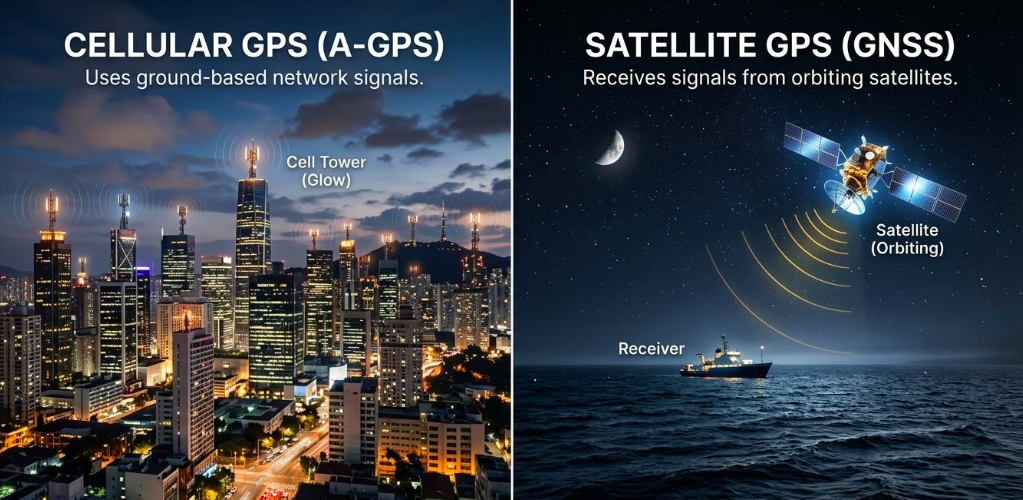
GPS tells a tracker where it is. But a separate communication layer is what actually sends that location to your phone or dashboard. There are three main options, cellular, satellite, and hybrid and the one you choose affects coverage, update speed, cost, and battery life.
Cellular GPS Trackers
Cellular GPS trackers utilize cellular networks (4G/LTE, LTE-M, or NB-IoT) to transmit location data to cloud servers. They represent approximately 85% of the GPS tracking market and offer the most cost-effective solution for vehicles and assets operating within mobile network coverage.
Cellular trackers enable:
- Real time tracking with updates every 10-30 seconds
- Driver alerts and geofence notifications within seconds
- Over-the-air configuration updates
These trackers need a mobile network to work. In remote areas, underground parking, or during international travel, tracking may stop if there’s no signal or roaming support. Monthly data plans usually cost $10-30.
Satellite GPS Trackers
Satellite GPS trackers don’t use mobile networks. They send location data through satellites in space, so they work even in remote areas like oceans, mountains, or places with no signal.
Common applications include:
- Cargo ships and offshore oil platforms
- Mining and exploration sites in remote areas
- Long-haul trucks crossing through areas with no cell coverage
- Expedition and ocean racing teams
Satellite devices and plans are more expensive, often 3-5 times higher than cellular options, with monthly fees starting around $30-$50. To control costs, most trackers send updates less often, usually every 1-5 minutes. In real-world use, these trackers only make sense when coverage is a problem. If your vehicles stay in cities or suburbs, a cellular tracker does the job at a much lower cost.
Hybrid and Multi-Network Trackers
Hybrid trackers combine cellular and satellite networks in one device. They use cellular by default, since it's faster and cheaper, It automatically switches to satellite whenever cell coverage runs out. You don't have to do anything. The tracker handles it on its own.
This makes them a great fit for assets that don't stay in one place. Think of a shipping container leaving a port in New York, crossing the Atlantic, and arriving in London. The tracker uses cellular on land, switches to satellite in the middle of the ocean, then picks up cellular again at the destination port, no gaps, no interruptions.
Since 2024, most new trackers come with this dual-network capability built in. That means fewer blind spots, coverage gaps are now under 1% in most cases. And since the tracker only jumps to satellite when it has to, you're not paying satellite rates the whole time.
If your vehicles or assets regularly travel through remote areas, cross borders, or move between land and sea a hybrid tracker, is the smartest choice.
Active vs Passive GPS Tracking
GPS tracking systems are also classified by how they deliver data: actively streaming in real time or passively logging for later retrieval.
Active (Real-Time) GPS Trackers
Active trackers transmit frequent location updates via cellular or satellite communication, typically every few seconds to minutes during movement. This enables:
- Live fleet dispatching and ETA predictions accurate to ±5 minutes
- Geofence breach alerts within seconds
- Immediate theft notifications
- Real-time driver behavior monitoring
Active tracking requires ongoing data plans and consumes more power, which matters for battery-only devices. For most business-critical applications, fleet management, valuable assets, safety monitoring, active tracking is the default choice.
Passive (Data-Logging) GPS Trackers
Passive GPS trackers store location data inside the device instead of sending it in real time. You can check the data later by connecting the tracker through USB, Bluetooth, or when it reconnects to a network. They’re mainly used for basic tasks like tracking mileage, reviewing trips, or situations where you want to avoid monthly data costs. Because they don’t send constant updates, they usually last much longer on battery and cost less to run. The downside is you don’t get live tracking.
There are no instant alerts, and if something goes wrong, you’ll only see it after the fact. That makes them less suitable for theft protection or real-time monitoring.
Tracking Behaviour: Update Frequency and Geofencing
Update frequency means how often the tracker sends its location. Some devices update every 5-10 seconds, while others may send updates once every hour to save battery. You should choose the update speed based on your needs. If you need live tracking (like fleet dispatch), frequent updates work best. For basic tracking, like checking if an asset is in place, less frequent updates are enough.
Geofencing lets you set virtual boundaries on a map. You’ll get alerts when a vehicle or asset enters or leaves those areas. Many tracking systems also let you create multiple zones and control how alerts work, such as how long something stays in one place or when it enters or exits a location.
Power, Battery Life and Maintenance
Hardwired trackers avoid battery concerns entirely but often include backup capacitors for anti-tamper alerts if power is cut. Portable trackers trade off between battery capacity, update frequency, and device size.
Consider realistic service intervals. Can your team recharge trackers monthly, quarterly, or only annually? Mismatched power expectations are among the most common buyer mistakes.
Durability, Weather Resistance and Installation Environment
IP ratings matter for exposed installations. IP65 handles dust and water jets; IP67 survives temporary immersion; IP69K withstands high-pressure washing. Asset trackers for construction, agriculture, or marine use should meet IP67+ standards.
Temperature ranges also vary. Units rated -40°C to 85°C handle most environments, but verify specifications for extreme climates.
How to Choose the Right Type of GPS Tracker for Your Situation
Choosing the right GPS solution starts with four questions:
- What are you tracking? Vehicles, trailers, equipment, people, or pets?
- Where does it operate? Urban areas with cellular coverage, remote locations requiring satellite, or international routes?
- How often do you need updates? Real-time dispatch versus daily check-ins?
- How long must devices operate unattended? Days, months, or years?
Small local delivery fleet: OBD-II plug-in trackers with 30-second cellular updates provide easy deployment and driver behavior insights at $15-25 monthly.
Regional construction company: IP67-rated battery asset trackers with motion-triggered reporting protect equipment across job sites at $20-30 monthly.
Family tracking teen driver: OBD-II tracker with geofencing and speed alerts delivers peace of mind with minimal installation hassle.
Trade-offs exist between installation effort and portability, cost and coverage, update frequency and battery life. Shortlist 1-2 tracker types, then compare specific models based on features, service reliability, and total ownership costs, not just upfront hardware price.
Conclusion
Choosing the right GPS tracker comes down to three simple things, what you're tracking, where it operates, and how often you need updates.
For vehicles and fleets, a hardwired or OBD-II tracker gives you reliable, real-time visibility with driver behavior data built in. For equipment and assets, a rugged battery-powered tracker keeps tabs on things without needing a power source. For remote locations, a satellite or hybrid tracker fills in the gaps where cell coverage runs out.
There's no single best tracker, just the right one for your situation. Use this guide to narrow down your options, then compare a few specific models based on coverage, battery life, and monthly costs before making a final decision.
If you're tracking vehicles in the US and want something affordable, reliable, and easy to set up, Lightning GPS trackers starting at $12.95 with no contracts or hidden fees.
Frequently Asked Questions
What is the most common type of GPS tracker?
The most common type is the cellular GPS tracker. It works over 4G networks, updates location every few seconds, and covers most everyday needs, from fleet management to personal vehicle tracking. Around 85% of all GPS trackers on the market use cellular connectivity.
Do GPS trackers work without a subscription?
Most real-time GPS trackers require a monthly data plan to transmit location over cellular or satellite networks. Passive (data-logging) trackers are the exception, they store data on the device itself and don't need a subscription, but you can only view data after connecting the device manually.
How accurate are GPS trackers?
Most GPS trackers are accurate to within 2-5 meters under good conditions, outdoors with a clear view of the sky. Accuracy can drop in built-up areas, underground, or in areas with heavy tree cover.
Can a GPS tracker work without cell service?
Yes, satellite GPS trackers work anywhere on Earth, including remote areas with no cell coverage. Hybrid trackers automatically switch between cellular and satellite, so you stay connected even when one network isn't available.
What is the difference between active and passive GPS tracking?
Active trackers send location data in real time so you can monitor movement live. Passive trackers record the data locally and you download it later. Active tracking is better for security and fleet management. Passive tracking works for basic mileage logging where real-time updates aren't needed.
Posted by Kellie Kendall on Mar 25th 2026